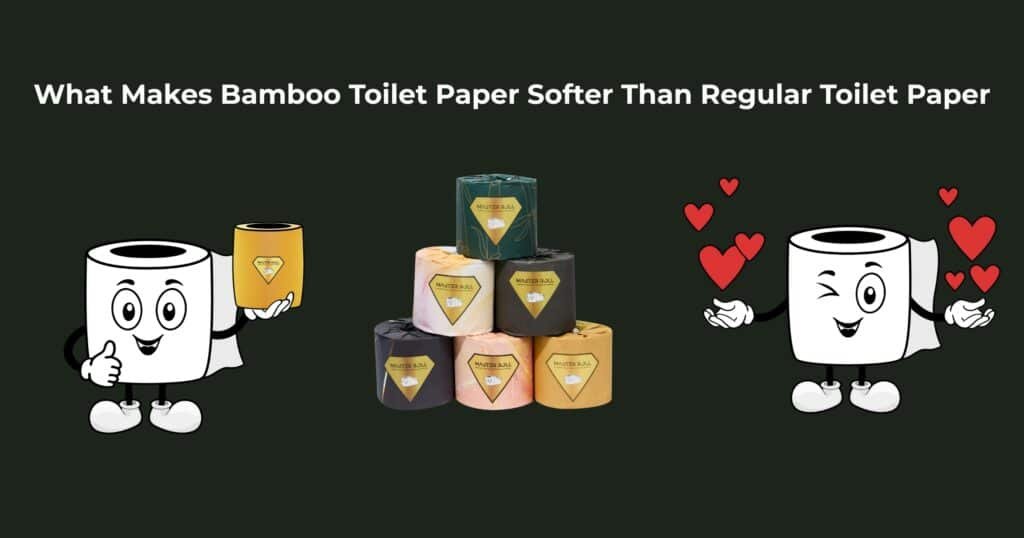
Short answer: yes, bamboo toilet paper can be very soft. But the softness doesn’t come from bamboo alone. It comes from the whole recipe: the blend of fibres, how the sheet is dried and creped, and how many plies are combined.
When it comes to toilet paper, softness matters. It’s something we use every day, and the difference between a thin, scratchy roll and a soft, cushioned one is easy to feel.
So what actually makes one roll feel softer than another, and where does bamboo fit in? Let’s take a closer look.
🌱 Softness starts with the fibre blend
Toilet paper is made from cellulose fibres: from wood, recycled paper or, in our case, bamboo. Different fibres do different jobs:
- Short hardwood fibres, such as eucalyptus, are about 0.7–0.9 mm long and are widely used to give tissue a smooth, velvety feel.
- Longer fibres, such as softwood and bamboo, add strength. Bamboo fibres are around two to three times as long as eucalyptus fibres, at about 1.7–2.2 mm in published fibre measurements.
That’s why most toilet paper is a blend. Manufacturers balance short fibres for softness against longer fibres for strength. Laboratory research suggests bamboo pulp can replace softwood pulp to add strength without losing softness. The finished feel still depends on how the paper is made.
🎋 How the paper is made matters as much as the fibre
Two rolls made from the “same” material can feel completely different. Much of the softness is created on the tissue machine:
- Creping: a blade scrapes the dry sheet off a large heated cylinder. This crumples it into tiny folds, giving tissue its soft, slightly stretchy feel.
- Drying method: some premium tissue is dried by blowing hot air through the sheet. This keeps it bulkier and more absorbent.
- Plies and embossing: combining several thin layers and embossing a pattern adds thickness and cushioning.
You can see each of these steps in our guide to how toilet paper is made.
🧻 What goes into Master Roll
Here’s what we can say about our own rolls:
- 3-ply: three layers of tissue for a thicker, cushioned sheet.
- 300 sheets on every roll.
- Unscented: no added fragrance or dyes.
- Bleached without elemental chlorine (ECF), using chlorine dioxide rather than chlorine gas.
If you prefer toilet paper without perfumes or dyes, an unscented roll like ours is a simple choice.
💪 Soft doesn’t mean weak
A common worry is that soft toilet paper must be fragile, or that a strong roll must feel stiff. In practice, manufacturers balance softness and strength through the fibre blend and the number of plies. Longer fibres, such as bamboo, help a sheet hold together, and three plies give it body without a stiff, heavy sheet. That’s why a well-made 3-ply roll can feel soft and still do the job.
📦 Even the packaging plays a role
Master Roll toilet paper is individually wrapped in paper. The wrap helps keep each roll clean and dry until you open it. There’s more on why we do this in why individually wrapped toilet paper is more hygienic.
🌍 Soft, and made from bamboo
Bamboo is a grass, not a tree. Its stems can be cut without destroying the root system, so a managed stand regrows and can be harvested again. That’s one of the reasons we chose bamboo. Whether bamboo tissue has a lower environmental footprint overall depends on how and where it is made. We look at both sides in the environmental impact of regular toilet paper vs bamboo.
❓ Quick questions
Is bamboo toilet paper softer than regular toilet paper?
Not automatically. Softness depends on the fibre blend, the drying and creping, and the number of plies. A well-made bamboo roll can feel as soft as a premium wood-pulp roll, and a cheap roll of either kind can feel rough. The best test is to try a pack for yourself.
Is 3-ply toilet paper softer than 2-ply?
It usually feels thicker and more cushioned, because three thin layers are combined. How soft it feels on the skin still depends on the fibres and on how each layer was made, so the ply count is a useful guide rather than a guarantee.
✨ Final thoughts
So, is bamboo toilet paper soft? It can be very soft. That softness comes from the whole recipe, not from bamboo alone: the fibre blend, the creping, the drying and the number of plies all play a part.
Master Roll brings these together in a 3-ply, unscented bamboo toilet paper, with every roll individually wrapped in paper. If you’d like to feel the difference for yourself, our bamboo toilet rolls come in 24-roll and 48-roll packs, with free UK delivery and free returns on unused packs within 30 days.