The short answer: toilet paper is made by turning plant fibres from wood, recycled paper or bamboo into a watery pulp. That pulp is spread into a very thin sheet on a moving mesh, then dried on a huge steam-heated cylinder known as a Yankee dryer. A blade scrapes the dry sheet off the cylinder, a step called creping that makes it soft and slightly stretchy. The resulting giant “parent reels” are then unwound, layered into plies, embossed and perforated. Finally they are wound onto cardboard cores, cut into rolls and wrapped.
So how is toilet paper made in more detail? Below, we walk through each stage and look at what the paper is actually made of. We also cover how it was made in the past, and what changes when the fibre is bamboo rather than wood.
What is toilet paper made of?
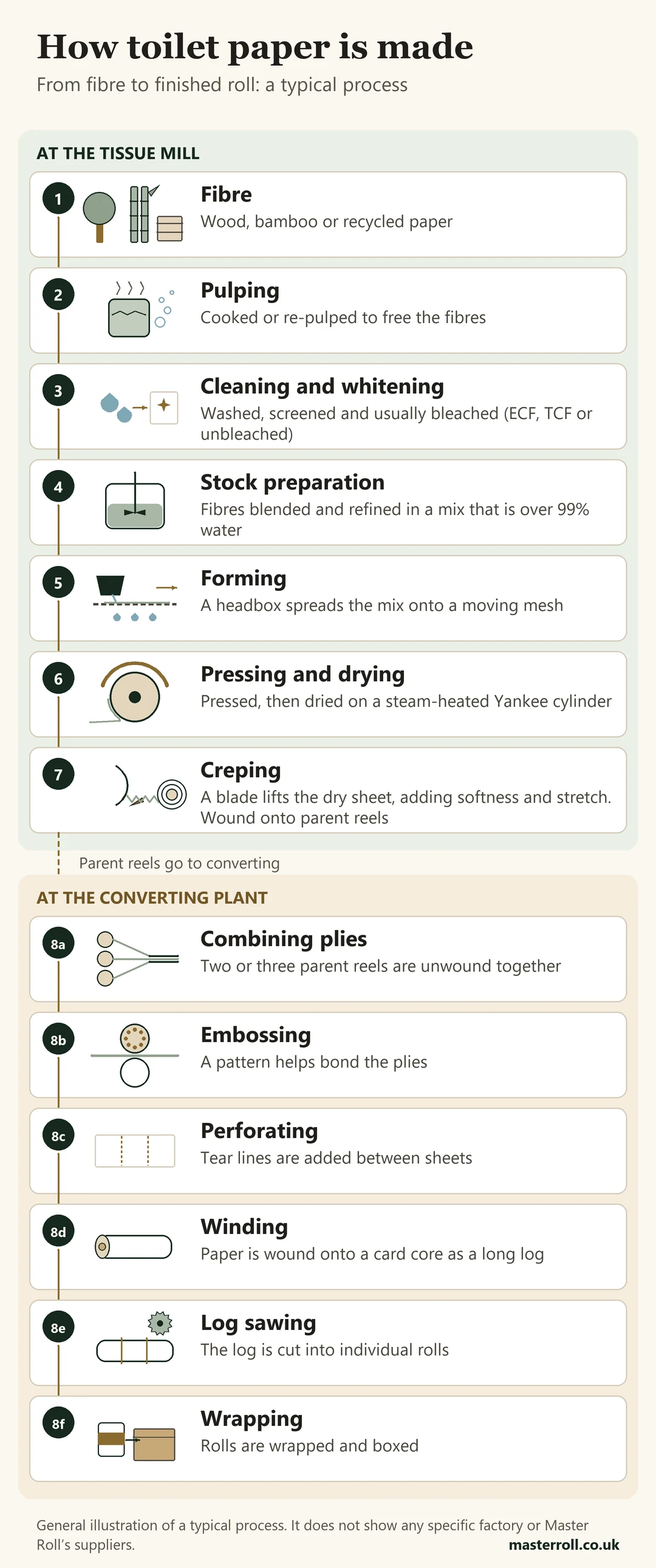
Toilet paper is almost entirely cellulose fibre: the tough, microscopic strands that give plants their structure. A great deal of water is used while it’s being made, but very little remains in the finished roll. The biggest difference between one roll and the next is where the fibre comes from.
| Fibre source | Typical fibre length | What it contributes | Things to know |
|---|---|---|---|
| Hardwood pulp (e.g. eucalyptus, acacia) | Short, about 0.7–0.9 mm | Softness and a smooth, velvety feel | Widely used for softness |
| Softwood pulp (e.g. pine, spruce) | Long | Strength and reinforcement | Usually a smaller share of the blend than hardwood (30% in one US study’s base case) |
| Recycled paper | Shorter and stiffer after repeated recycling | Reuses waste paper | Fibres bond less well, so recycled tissue tends to be weaker and less soft |
| Bamboo pulp | About 1.7–2.2 mm, roughly twice as long as eucalyptus (peer-reviewed measurements of pulp and raw fibre) | Strength. Laboratory research suggests bamboo pulp can replace softwood pulp to add strength without losing softness | A grass, not a tree. Bamboo is an important pulp raw material in China, India, Thailand and other Asian countries |
Most conventional toilet paper is a blend: mostly short hardwood fibre for softness, with some longer fibre for strength. Small quantities of process chemicals are also used. These include the chemicals that cook and whiten the pulp. There is also a coating sprayed onto the drying cylinder, which helps the sheet stick to it and protects the cylinder surface.
How is toilet paper manufactured? Step by step
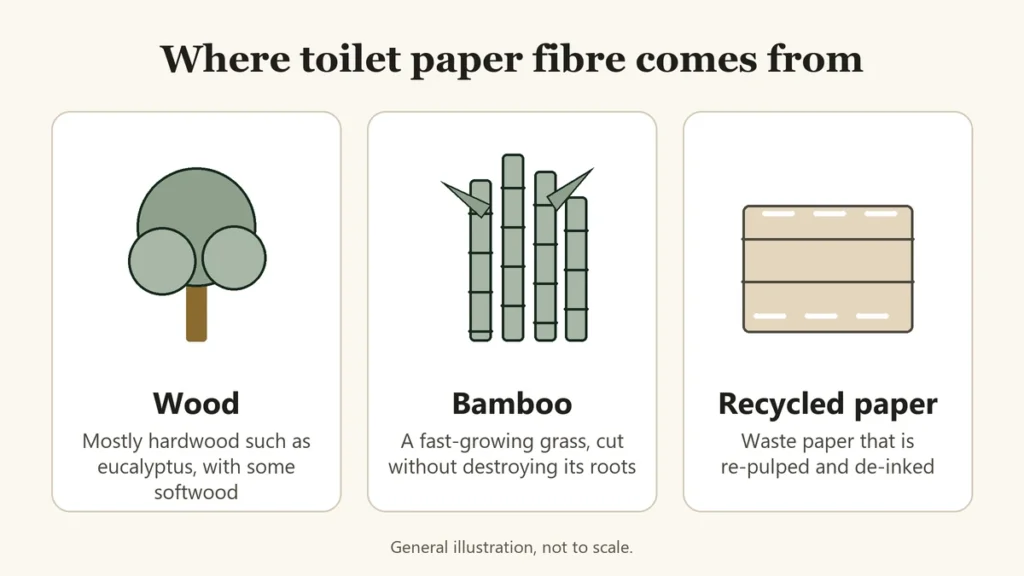
Toilet paper is usually produced in two kinds of factory. At a tissue mill, fibre becomes enormous reels of thin paper. At a converting plant, those reels are turned into the rolls you buy. Sometimes both happen on one site.
| Step | Where | What happens |
|---|---|---|
| 1. Sourcing fibre | Forest, plantation or recycling stream | Timber, bamboo or waste paper is collected |
| 2. Pulping | Pulp mill | Chips are cooked to separate the fibres, or waste paper is re-pulped |
| 3. Cleaning and whitening | Pulp mill | Pulp is washed, screened and usually bleached |
| 4. Stock preparation | Tissue mill | Fibres are blended and refined in a watery mix |
| 5. Forming | Tissue machine | The mix is spread onto a moving mesh and water drains away |
| 6. Pressing and drying | Tissue machine | The sheet is pressed and dried on a heated Yankee cylinder |
| 7. Creping | Tissue machine | A blade scrapes the sheet off the cylinder, creating softness and stretch |
| 8. Converting | Converting plant | Plies are combined, embossed, perforated, wound, cut and wrapped |
1. Sourcing the fibre
Virgin fibre comes from harvested trees or, for bamboo toilet paper, from bamboo stems, which are called culms. Recycled tissue starts with bales of waste paper. This first step drives most of the environmental debate, which we cover further down.
2. Pulping: freeing the fibres
In chemical pulping, chips of wood or bamboo are cooked in a chemical solution. It dissolves lignin, the natural “glue” holding plant fibres together, so the cellulose fibres can separate. The kraft process is the most common chemical method, and bamboo can be kraft-pulped too.
Recycled toilet paper starts differently: waste paper is soaked and churned back into pulp. Contaminants are screened out and ink is removed, notably by flotation, where rising air bubbles carry ink particles to the surface as a froth that is then removed. Washing stages are also used.
3. Cleaning and whitening
Most pulp is washed and then bleached to make it whiter and cleaner. The method matters, because it’s where terms like “chlorine-free” come from:
- Elemental chlorine bleaching has largely been replaced by ECF and TCF methods in modern pulp mills.
- ECF (elemental chlorine free) bleaching uses chlorine dioxide instead of chlorine gas. It is now the dominant method. The US industry body AF&PA puts it at more than 95% of worldwide pulp production. The Environmental Paper Network, which campaigns for chlorine-free bleaching, puts it at over 90% of bleached kraft pulp.
- TCF (totally chlorine free) bleaching uses no chlorine compounds at all.
- Unbleached pulp skips whitening, which is why some eco papers are a natural beige.
Bleaching by-products are regulated. In the US, for example, effluent limits for dioxins and furans apply at bleached kraft mills, including the tissue made at those mills.
4. Stock preparation
At the tissue mill, the pulp is diluted with plenty of water. The fibre types are then blended to a recipe: more short fibre for softness, more long fibre for strength. Refining then lightly roughens the fibres so they bond into a sheet.
5. Forming the sheet
A headbox spreads the watery mixture, which is more than 99% water, evenly across a fast-moving mesh known as the “wire” or forming fabric. Water drains away, leaving the fibres knitted into a thin, fragile web. Tissue is very light: one modern tissue machine is specified for sheets of roughly 12–31 grams per square metre.
6. Pressing and drying on the Yankee
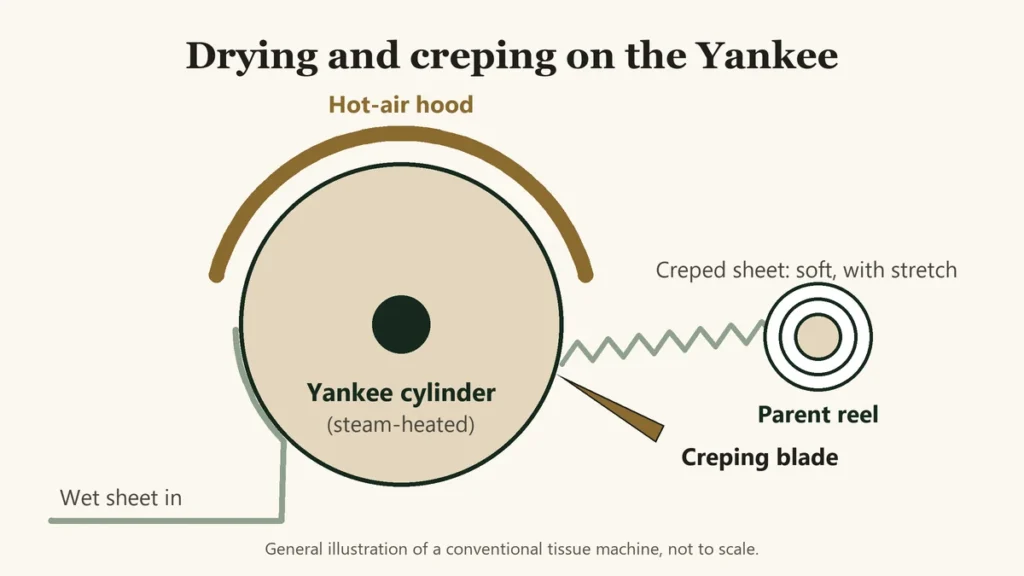
The wet web is pressed to remove more water, then transferred onto the Yankee dryer. This is a giant steam-heated metal cylinder that the machine maker Valmet calls the heart of the tissue machine. On one modern line, the Yankee measures 16 feet (about 4.9 m) across and works with a hot-air hood fitted over the cylinder.
Some premium tissue uses through-air drying (TAD) instead. Hot air is blown through the sheet to dry it, often before a final pass over a Yankee. This keeps the paper bulkier and more absorbent, while conventional pressed tissue is denser and stronger.
7. Creping: where the softness comes from
As the dry sheet comes off the Yankee, a metal creping blade (also called a doctor blade) scrapes it away from the cylinder. This crumples the sheet into countless microscopic folds, giving tissue its soft, slightly crinkly feel and its bulk. Researchers note that most of tissue’s stretch comes from creping. The creped paper is then wound onto very large parent reels.
8. Converting: from parent reel to roll
At the converting plant, several parent reels are unwound together:
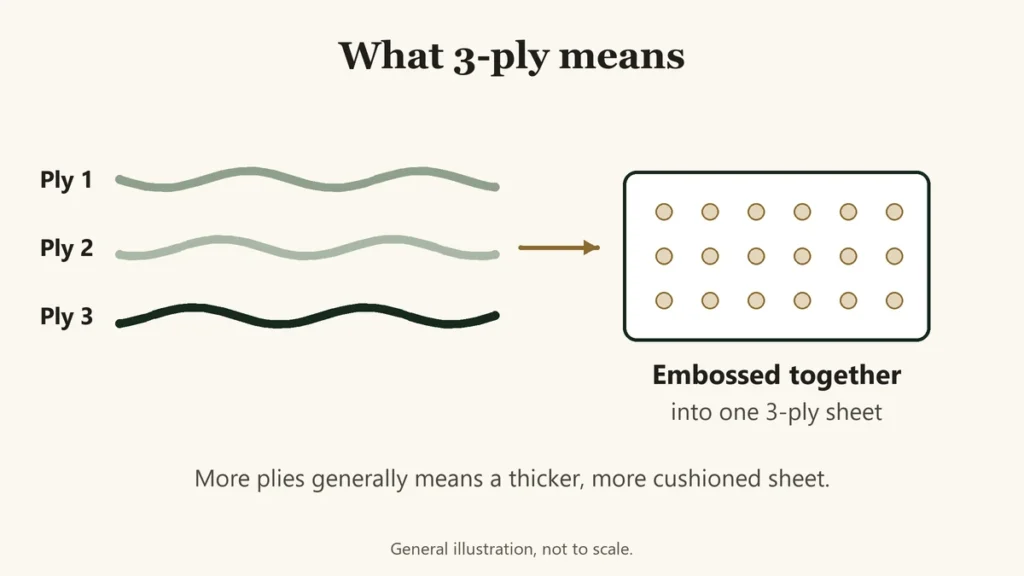
- Plies are brought together. Typically, two reels make 2-ply and three make 3-ply.
- Embossing presses a pattern into the layers, which helps bond the plies and adds softness and thickness. Many lines also use a light glue lamination.
- Perforating adds the tear lines between sheets.
- Winding wraps the paper around a cardboard core into a long “log”, and a log saw slices each log into individual rolls.
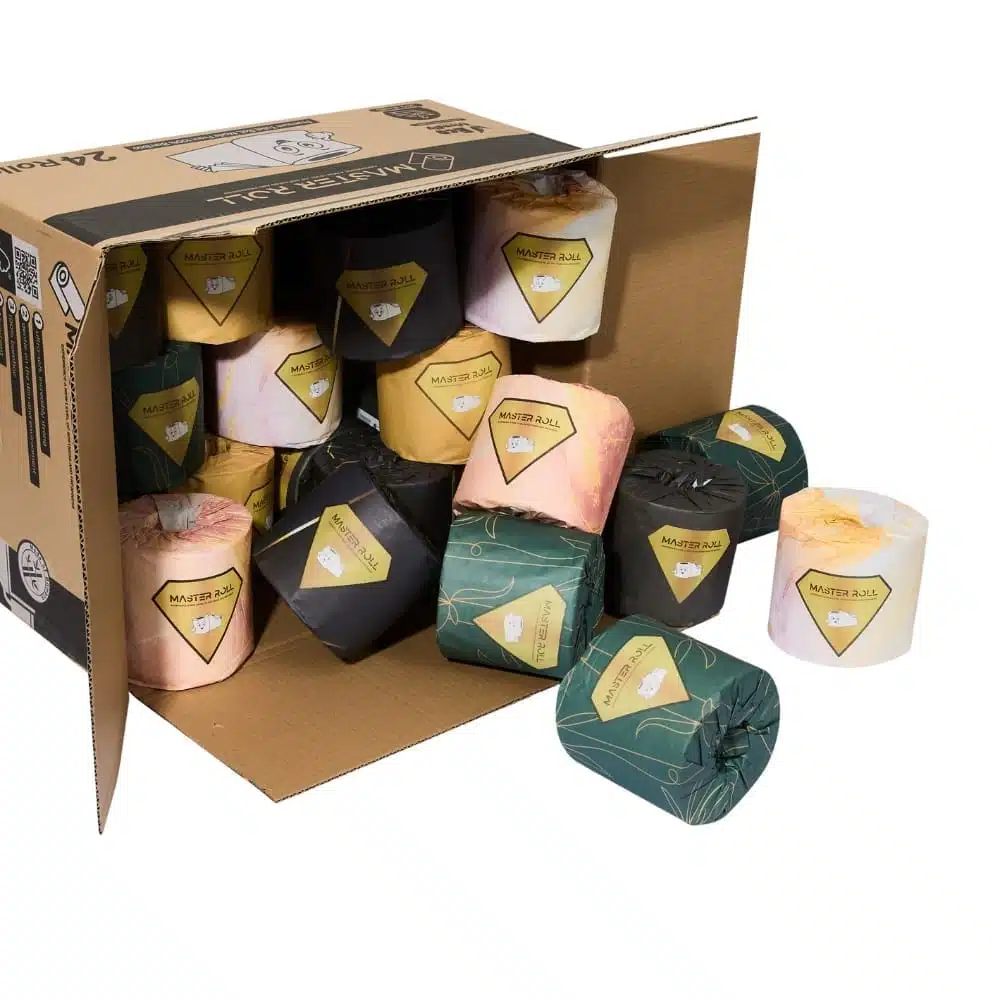
- Wrapping and packing: rolls are bundled in plastic film or, as Master Roll does, wrapped in paper (why we wrap every roll in paper) and boxed.
Kitchen roll can be treated with wet-strength additives so it holds together when wet. Toilet tissue is designed the other way round: to lose most of its strength in water so that it breaks up after flushing.
How was toilet paper made in the past?
Papermaking itself can be traced back to China in about AD 105. For most of history, though, people used whatever was to hand. Toilet paper as a product is surprisingly recent:
- c. 1857: Joseph Gayetty sells packaged flat sheets of “medicated paper” in the United States.
- 1871: Albany-based inventor Seth Wheeler patents a roll of paper perforated between the sheets. He later patented several further improvements to perforated paper.
- 1890: according to Kimberly-Clark, which now owns the Scott brand, the Scott Paper Company begins marketing rolls of tissue made specifically for use as toilet paper.
- 1935: Northern Tissue advertises its toilet paper as “splinter-free”.
- 1942: Andrex is first produced at St Andrew’s Mill in Walthamstow, now part of London.
Since then, tissue-making has added much faster machines, through-air drying, recycled fibre and alternative fibres such as bamboo.
How is bamboo toilet paper made?
Bamboo toilet paper goes through the same mill and converting process described above. The difference is the fibre at the start:
- Harvesting: bamboo is a grass, and its culms can be cut without destroying the root system, so a managed stand regrows and can be harvested repeatedly. According to the UN Food and Agriculture Organization (FAO), commercially important species usually mature in four to five years and can be harvested about four times as often as most eucalyptus. Growth rates vary hugely by species. The FAO gives a range of roughly 7.5–40 cm a day, and the oft-quoted “over a metre a day” is a record, not the norm.
- Pulping and whitening: the culms are chipped and pulped chemically, typically by the kraft or soda process. The pulp is then whitened or left unbleached, using the methods explained above.
- Tissue-making and converting: the bamboo pulp is formed, dried, creped and converted on standard tissue equipment.
Bamboo fibres are about as fine as eucalyptus fibres but roughly twice as long: about 1.7–2.2 mm compared with 0.7–0.9 mm in peer-reviewed fibre measurements. That length is why bamboo is valued for strength. Softness depends heavily on the fibre recipe, the machine and the creping, not on bamboo alone.
A note on “100% bamboo”: in 2024, Which? had five toilet papers sold as bamboo-only fibre-tested. Three were found to be made mostly of wood, largely eucalyptus (one brand disputed the test method), and two did test as 100% bamboo. If fibre content matters to you, look for brands that can show test evidence.
You can read why we chose bamboo for our own reasons.
Is bamboo toilet paper better for the environment?
It can be, but it depends on how and where it’s made. A responsible answer has to cover both sides.
In bamboo’s favour:
- It regrows quickly and can be harvested often.
- The environmental group NRDC says bamboo often has a lower footprint than forest fibre.
What complicates it:
- Some bamboo plantations were created by clearing primary forest, and NRDC says bamboo from such areas should be avoided.
- A 2025 peer-reviewed life-cycle study by NC State University researchers, published in the journal Cleaner Environmental Systems, compared tissue made in China from a 70% bamboo, 30% eucalyptus blend with wood-based tissue made in the US. The bamboo-blend tissue came out at about 2,400 kg CO₂e per air-dry ton, against 1,824 for the US tissue. In the study, the type of tissue machine affected emissions more than the fibre did. The researchers put most of the gap down to China’s coal-heavy electricity rather than the bamboo itself, and said it largely disappeared with cleaner power.
- Shipping, packaging and how much paper each household uses all add to the footprint.
- In NRDC’s 2025 US scorecard, the top grades went to products with high recycled content, while certified bamboo products mostly earned B grades. Recycled tissue tends to be less soft.
So bamboo can be a strong option, particularly compared with virgin wood pulp from sensitive forests, but no single fibre wins on every measure. There’s more detail in our guide to the environmental impact of regular toilet paper vs bamboo.
What makes toilet paper soft and strong?
Four things matter most:
- Fibre recipe: short hardwood fibres add softness, while longer softwood or bamboo fibres add strength.
- Machine type: through-air-dried tissue is bulkier and more absorbent; conventional pressed tissue is denser.
- Creping: the blade-and-cylinder step creates most of the stretch and much of the softness.
- Plies and embossing: more plies add thickness and cushioning, and embossing binds them and adds loft.
That’s why two rolls made from the “same” material can feel completely different. For a shopper’s checklist covering ply, sheets per roll, strength and absorbency, see what makes a high-quality toilet roll.
What about chemicals?
“Chemical-free” isn’t a realistic description of any toilet paper or loo roll, because pulping itself relies on chemistry. The useful questions are which chemicals are used and how they’re controlled. Look at the whitening method (ECF, TCF or unbleached), whether any fragrance, lotion or dye is added, and how the mill is regulated. Pulp and tissue mills operate under environmental permits and effluent limits that vary by country.
You may have seen headlines about PFAS (“forever chemicals”) in toilet paper. A 2023 study published in Environmental Science & Technology Letters tested 21 toilet papers from four world regions and found PFAS in them. It concluded that toilet paper is a potentially major source of certain PFAS reaching wastewater. The study looked at wastewater only: it did not assess skin contact or health effects, and it found no significant difference between recycled and non-recycled papers. It’s a useful finding for wastewater science, not evidence that using toilet paper is harmful.
How is Master Roll made?
Here’s what we can say about our own rolls:
- Fibre: made from bamboo.
- Construction: 3-ply, with 300 sheets on every roll: 7,200 sheets in a 24-roll pack and 14,400 in a 48-roll pack.
- Unscented: no added fragrance or dyes.
- Whitening: bleached without elemental chlorine (ECF), using chlorine dioxide rather than chlorine gas.
- Packaging: each roll is individually wrapped in paper, and the rolls are packed in a paper box.
- Delivery and returns: free UK delivery, usually within 2–5 business days, with same-day dispatch on orders placed before 12pm. Unopened packs can be returned within 30 days of delivery for a full refund, with free returns (returns policy).
If you’d like to try it, our bamboo toilet rolls come in two sizes. The 24-roll pack is our everyday size, and the 48-roll pack has the lowest price per sheet.
Frequently asked questions
What is toilet paper made of?
Toilet paper is made of cellulose fibres from wood pulp (usually a blend of hardwood and softwood), recycled paper, or other plant fibres such as bamboo. Water is used heavily during manufacture, along with small amounts of process chemicals for pulping, whitening and creping.
How is toilet paper produced from recycled paper?
Waste paper is soaked and churned back into pulp, then screened to remove contaminants. It is de-inked, notably by flotation, where air bubbles carry ink to the surface as a froth that is removed. The cleaned pulp then goes through the same forming, drying and creping steps as virgin pulp.
Is toilet paper made from trees?
Much of it is. Conventional toilet paper is commonly made from virgin wood pulp, often eucalyptus hardwood blended with softwood. Recycled paper and bamboo, which is a grass, are the main alternatives.
How is bamboo toilet paper made?
Bamboo culms are chipped and pulped chemically, typically by the kraft or soda process, and the pulp is then whitened or left unbleached. It is made into tissue on the same kind of machines as wood-based toilet paper. The main difference is the raw material.
Is bamboo toilet paper bleached?
Many bamboo toilet papers are whitened, although some are sold unbleached and are a natural beige colour. The method varies: ECF uses chlorine dioxide, and TCF uses no chlorine compounds. Check what a brand says about its own process. Master Roll is bleached without elemental chlorine (ECF).
What does 3-ply mean?
3-ply means each sheet is made from three layers of tissue, combined and usually embossed together during converting. More plies generally means a thicker, more cushioned sheet. Master Roll is 3-ply, with 300 sheets per roll.
Does toilet paper break down after flushing?
Toilet paper is designed to lose strength and break up in water, unlike wet wipes. UK water companies ask people to flush only the “3Ps”: pee, paper and poo. In a Water UK study of sewer blockages, wipes made up about 93% of the material. Toilet paper and other products designed to be flushed made up less than 1%. If you have a septic tank, see our guide is bamboo toilet paper septic safe?
Why is some toilet paper softer than others?
Softness comes from the fibre blend (short hardwood fibres feel softer), the drying method (through-air drying creates bulk), creping, and the number of plies and the embossing.