The short answer: toilet paper’s environmental impact depends mostly on its fibre source, how the pulp is made and whitened, the energy used at the mill, and packaging and transport. Bamboo can be a lower-impact fibre than virgin wood pulp, but it depends on how and where it is made, and no single fibre wins on every measure.
Toilet paper is one of the most used household items. We don’t often think about it: we just buy it, use it and move on. But not all toilet paper is made the same way, and the choices behind each roll affect its footprint.
So, what’s the difference between regular toilet paper and bamboo toilet paper? Why does it matter?
In this post, we break down the environmental impact of both, including the parts that aren’t so simple, so you can make an informed choice for your home.
1. Where Regular Toilet Paper Comes From
Much conventional toilet paper is made from virgin wood pulp, often eucalyptus hardwood blended with some softwood. Where that wood comes from matters:
- 🌳 Forests: when pulp comes from natural forests rather than well-managed plantations, logging can degrade those forests.
- 🐾 Habitats: forests are home to many species, so clearing or degrading them affects wildlife.
- 🌎 Energy and carbon: pulping, drying and transport all use energy, and forests store carbon.
Recycled paper is the other main source. It reuses fibre that already exists, although recycled tissue tends to be less soft because its fibres bond less well.
2. Bleaching and Processing: Is Any Toilet Paper Chemical-Free?
Most toilet paper, bamboo included, is whitened during pulping, and pulping itself relies on chemistry, so no toilet paper is truly chemical-free. The useful questions are which bleaching method is used and how it’s controlled. Our guide to how toilet paper is made explains each step, but in short:
- Elemental chlorine: older bleaching with chlorine gas produced by-products such as dioxins, which is why it has largely been replaced in modern pulp mills and why mill effluent is regulated.
- ECF (elemental chlorine free): uses chlorine dioxide instead of chlorine gas, and is now the most widely used method.
- TCF (totally chlorine free): uses no chlorine compounds at all, while unbleached paper skips whitening altogether.
Master Roll is bleached without elemental chlorine (ECF), and it’s unscented, with no added fragrance or dyes.
3. Packaging Waste: Plastic vs. Paper
Many toilet roll multipacks are wrapped in plastic film. That film:
- Is single-use: it’s thrown away as soon as the pack is opened
- Can’t be recycled everywhere: whether you can recycle soft plastic film depends on your council or a store collection point
Paper wrapping avoids that film. Master Roll wraps each roll individually in paper instead of plastic film. You can see both pack sizes on our bamboo toilet rolls page.
4. Why Bamboo Toilet Paper Is Different
Now, let’s look at bamboo toilet paper, like Master Roll.
🌱 Bamboo is a grass, not a tree. It grows quickly: some bamboo species can grow up to about 40 cm a day at peak growth.
🌿 When bamboo is harvested, the root system stays in place, meaning it can regrow without replanting.
🌾 According to the UN Food and Agriculture Organization (FAO), commercially important species usually mature in four to five years and can be harvested about four times as often as most eucalyptus.
That makes bamboo a fast-renewing fibre. Whether it’s the more sustainable choice overall depends on how and where it’s grown and made, which is what the next section looks at.
5. Is Bamboo Toilet Paper Better for the Environment?
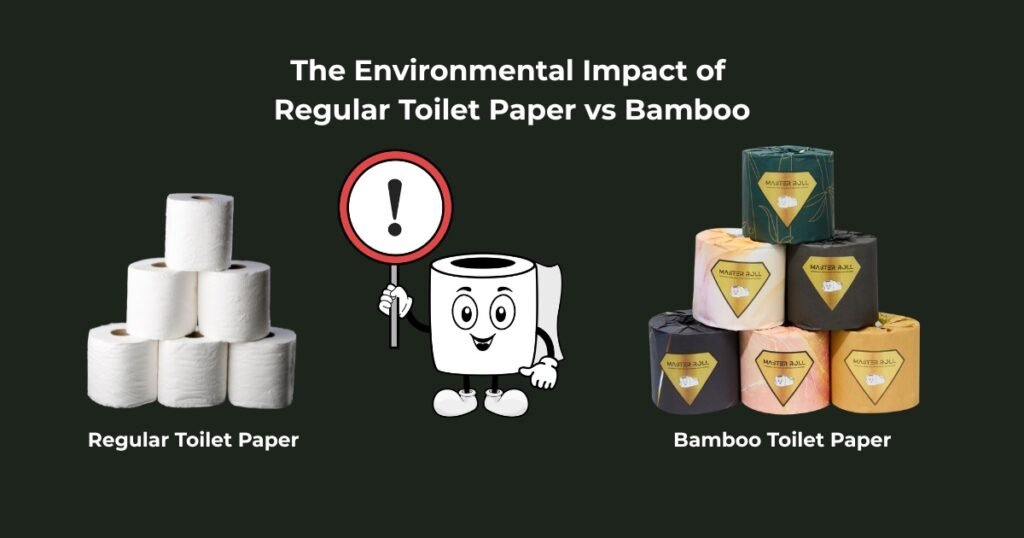
It can be, but it depends on how and where it’s made. Here’s how the two compare at a glance:
| Category | Regular Toilet Paper | Bamboo Toilet Paper |
|---|---|---|
| Raw material | Usually virgin wood pulp, or recycled paper | Bamboo, a fast-growing grass |
| Harvest | Trees are felled, then replanted or regrown | Stems are cut and the plant regrows; the FAO says bamboo can be harvested about four times as often as most eucalyptus |
| Packaging | Varies; many multipacks use plastic film | Varies by brand (Master Roll: each roll wrapped in paper) |
| Whitening | Usually bleached; virgin pulp is mostly ECF | Usually bleached; varies by brand (Master Roll: ECF) |
| Carbon footprint | Depends heavily on the mill’s energy and on transport | The same. In one 2025 study, coal-heavy power gave a China-made bamboo blend a higher footprint than US wood-based tissue |
What complicates the picture:
- Where it’s grown: some bamboo plantations were created by clearing primary forest, and the environmental group NRDC says bamboo from such areas should be avoided.
- How it’s made: a 2025 peer-reviewed life-cycle study by NC State University researchers found that the type of tissue machine affected emissions more than the fibre did. Most of the gap between China-made bamboo-blend tissue and US wood-based tissue came from China’s coal-heavy electricity.
- Recycled paper: in NRDC’s 2025 US scorecard, the top grades went to products with high recycled content, although recycled tissue tends to be less soft.
Bamboo can be a good choice, especially instead of virgin pulp from sensitive forests, but it isn’t automatically greener. Transport, packaging and how much paper each household uses matter as well.
6. What Goes Into the Roll?
The fibre isn’t the only thing to check. Some toilet papers have added fragrance, lotion or dyes, so if you’d rather avoid them, check the pack.
Master Roll is:
- Unscented, with no added fragrance or dyes
- 3-ply, with 300 sheets on every roll
- Bleached without elemental chlorine (ECF), using chlorine dioxide rather than chlorine gas
Softness comes from the whole recipe (the fibre blend, creping and the number of plies), not from bamboo alone.
7. How Can You Reduce Your Toilet Paper Footprint?
Whichever fibre you choose, a few simple habits help:
- Choose a brand that’s clear about its fibre, how it’s whitened and where it’s made.
- Prefer paper or card packaging to plastic film.
- Use only what you need, and flush only the 3Ps (pee, paper and poo), as UK water companies advise.
Frequently Asked Questions
What is the downside of bamboo toilet paper?
It isn’t always the lower-impact choice. Some bamboo is grown on land cleared of primary forest, transport adds to the footprint when it’s shipped a long way, and a mill running on coal-heavy power can give it a higher carbon footprint than wood-based tissue. It can also cost more than budget supermarket rolls.
What is the carbon footprint of toilet paper?
It varies widely with the mill’s energy source, the type of tissue machine and transport. In one 2025 peer-reviewed study, US-made wood-based tissue came out at about 1,824 kg CO₂e per air-dry ton, and a China-made 70% bamboo, 30% eucalyptus blend at about 2,400 kg, mostly because of coal-heavy electricity.
Why is toilet paper bad for the environment?
It isn’t all bad, but it’s a single-use product made in huge volumes. The main impacts come from the fibre (especially virgin pulp from sensitive forests), the energy and water used at the mill, whitening, plastic packaging and transport.
Final Thoughts
The type of toilet paper you use does make a difference, but the honest answer is that it depends on more than the fibre. Bamboo regrows quickly after harvest, paper wrapping avoids plastic film, and how the paper is made matters as much as what it’s made from.
With Master Roll you get:
- Soft, strong 3-ply sheets, 300 to a roll
- Toilet paper made from bamboo
- Bleached without elemental chlorine (ECF), with no added fragrance or dyes
- Each roll individually wrapped in paper
Delivery is free across the UK, usually within 2–5 business days, and unused packs in their original packaging can be returned free within 30 days.
Shop our bamboo toilet rolls 🧻